
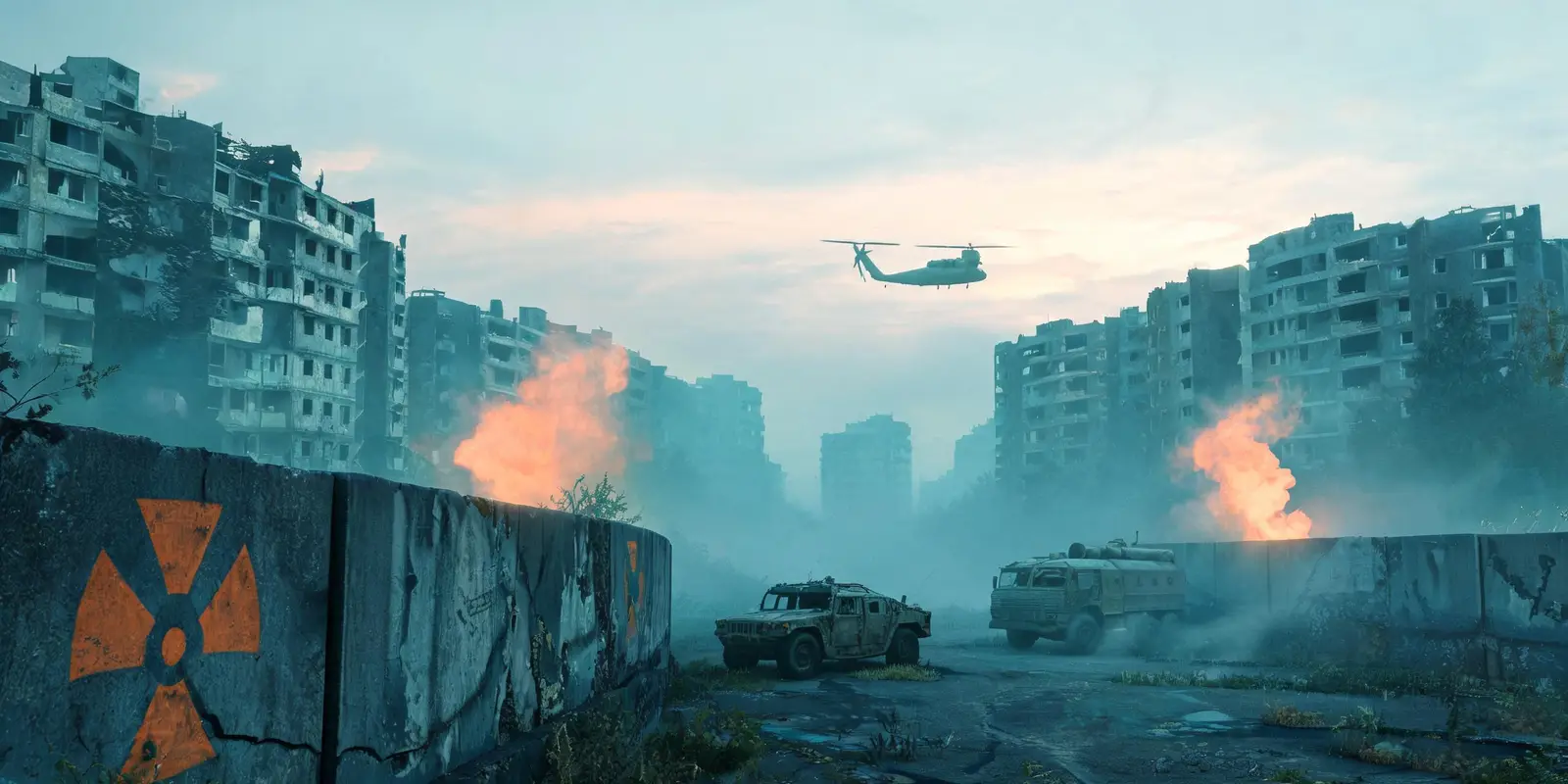
What DMZ is now
DMZ is Call of Duty's extraction shooter, rebuilt as a full third mode. You deploy into the Hajin exclusion zone as a shadow CIA asset, complete story and dynamic operations, loot weapons and technology, fight or avoid rival operators, and extract before the zone escalates beyond your squad's ability to survive.
The mode is directly tied to the campaign. Hajin is the region left behind after the invasion, and the campaign's post-credits scene is the reason you are there. If you have not finished the story, the ending explained page covers the handoff.
Access and timing
| Event | Date |
|---|---|
| DMZ early access | October 20, 1 PM ET, digital preorders only |
| Full launch | October 23 |
| Season 1 content | Expected November 6 |
DMZ progress made during early access persists. If you start on October 20, you keep your level, stash and unlocks when the full game opens.
The Hajin map
Hajin sits in a tri-point region bordering Russia and the Korean peninsula. It is one of the largest environments Call of Duty has built, and it is designed around exploration rather than a single lane.
| Point of interest | What it is |
|---|---|
| Hajin City | The remains of the urban battlefield from the campaign |
| Fallout reactor | Irradiated reactor site; gas mask required in the eastern fallout |
| Prison complex | Heavily secured facility with high-value loot |
| Military Base | Defended military installation with vehicles and armour |
| Casino | A derelict casino with a vault that can be cracked without alerting rival squads |
| Port and waterways | Hidden entrances accessible only by water |
Weather changes the map. Rain reduces visibility, fog turns familiar routes into navigation gambles, and overcast skies make long-range identification harder. Vehicle convoys move along the roads, aircraft cross the sky, and hostile forces reposition WMDs and strategic assets between matches.
The core loop
Prepare at the FOB
Check orders, move gear from stash to your operator's backpack, buy or craft what you need, and pick a free loadout if you are running low.
Choose a deployment
Pick a story mission, a dynamic operation, or free roam. Low-threat edges are safer for loot runs; the reactor and prison are high-risk, high-reward.
Infiltrate and loot
Prioritise weapons, attachments, valuables, keys and crafting materials. Use the Stealth Meter to avoid AI patrols before they spot you.
Manage threat
Every fight raises threat. Reinforcements, armoured troops and Deathstalker helicopters arrive if you stay loud too long.
Extract
Call the chopper, defend the landing zone, and leave before a rival squad decides your loot is easier than their own.
The Stealth Meter
Solo players get a dedicated stealth system. When an AI enemy is close to spotting you, an audio cue plays and a HUD indicator moves from white to yellow to orange. Go prone or break line of sight before it reaches orange. The meter does not make you invisible; it gives you a window to avoid a fight you cannot win.
Suppressed weapons, flashlights off, and avoiding open roads all reduce detection. The trade-off is that suppressed weapons do less damage and often have worse range, which matters when a squad does spot you.
Threat escalation and enemies
Hajin's threat system tracks your activity. The more you fight, the more the zone responds.
- Lieutenants lead specialised units and guard high-value areas.
- Tanks appear at high threat and can flatten a squad in the open.
- Drone swarms track and pressure players who stay in one place.
- Deathstalker helicopters are dispatched to hunt players who have attracted too much attention.
- Juggernauts and Elite Strike Teams are sent after high-threat squads.
The counter-play is pace control. Rotate after every fight, break contact before the next wave, and extract while you still have armour and ammo. A squad that wins every fight but stays in the same block will eventually lose to the escalation system.
The Forward Operating Base
The FOB is the hub between deployments. It is not cosmetic; it is where progression actually happens.
- Orders and objectives — track active missions and completion rewards.
- Stash and loadout — a persistent inventory of weapons, equipment, consumables and valuables, shared across deployments. Each active operator has their own backpack and loadout.
- Wallet — DMZ Cash for the Gunsmith and vendors.
- 3D Printer — craft items and gear from materials.
- Firing range — test a weapon before you risk it.
- Bounty boards — optional high-risk contracts.
- Upgrades — expand stash size and unlock services as you level.
The FOB visually evolves as you progress. It is also a social space where squads can regroup and new players can be onboarded.
Loot, crafting and weapon condition
DMZ uses a persistent inventory. Weapons you extract with can be kept, used, or upgraded at the FOB Gunsmith. Weapon levels are shared with multiplayer, so anything you level in MP is available here.
- Looting — weapons, attachments, armour, keys, valuables and crafting materials.
- Crafting — the 3D Printer turns materials into gear.
- Weapon condition and variants — weapons can spawn with conditions and unique variants; check before you equip.
- Weapon Manuals — found in Hajin and used to construct weapons.
- Recovery systems — let you rebuild or reclaim lost gear over time. The exact insurance rules are explained in-game; do not assume your best blueprint is safe.
The practical rule: never take a weapon you cannot afford to lose. Run cheap or free loadouts until you have a comfortable stash, then start bringing your good guns.
PvP and player encounters
Hajin is a live server. Other operators are not automatically hostile, but they are not your friends.
- Rogue operators hunt players for loot and infamy.
- Negotiation can work; proximity and numbers matter more than voice chat.
- Betrayal is part of the mode. Do not stand shoulder-to-shoulder with a stranger over a vault.
- Extraction is the most dangerous moment. A squad that waits for the chopper is exposed and loud.
If you want to avoid PvP, deploy at the edges, avoid the prison and reactor, and extract early. If you want PvP, hunt the extraction lanes and the high-value POIs.
A first-deployment plan that works
1. Use the free loadout. Do not bring your best gun on run one. 2. Deploy to a low-threat edge POI. Loot residential buildings, not the military base. 3. Bring a suppressor and a gas mask. The mask is mandatory in the eastern fallout; the suppressor keeps the Stealth Meter white. 4. Take one contract, not three. Completing one and extracting is worth more than dying with three. 5. Extract at the first safe window. Do not stay for "one more building." 6. Bank your loot at the FOB. Move valuables into the stash before you redeploy. 7. Level DMZ to 10. The Gunsmith unlocks and the mode opens up.
What to do after your first extraction
- Push the story missions to continue the campaign narrative.
- Unlock the FOB upgrades that expand stash and services.
- Learn the prison and reactor routes with cheap gear before bringing a squad.
- Check the Warzone page for the Season 1 Hajin battle royale integration.
DMZ is the mode most likely to keep you playing after the campaign. It is also the mode that punishes greed hardest. Extract early, extract often.
FAQ
What is DMZ in Modern Warfare 4?
A full extraction-shooter mode set in the Hajin exclusion zone. You deploy with a persistent stash, complete story and dynamic operations, loot gear, fight or avoid rival players, and extract.
When can I play MW4 DMZ?
DMZ early access opened October 20 at 1 PM ET for digital preorders. The full game, including DMZ for everyone, launches October 23.
Does DMZ progress carry over?
Yes. DMZ level, stash and unlocks persist from early access into the full game and across seasons.
Is DMZ PvP?
Yes. Hajin is a live server with rival operators, rogue players and extraction camping. You can avoid fights, negotiate, or hunt players, but you cannot opt out of PvP entirely.